
2026-10-16
Calif at Hexacon 2026: reading an untethered iOS 27.0.1 demo as reverse engineers
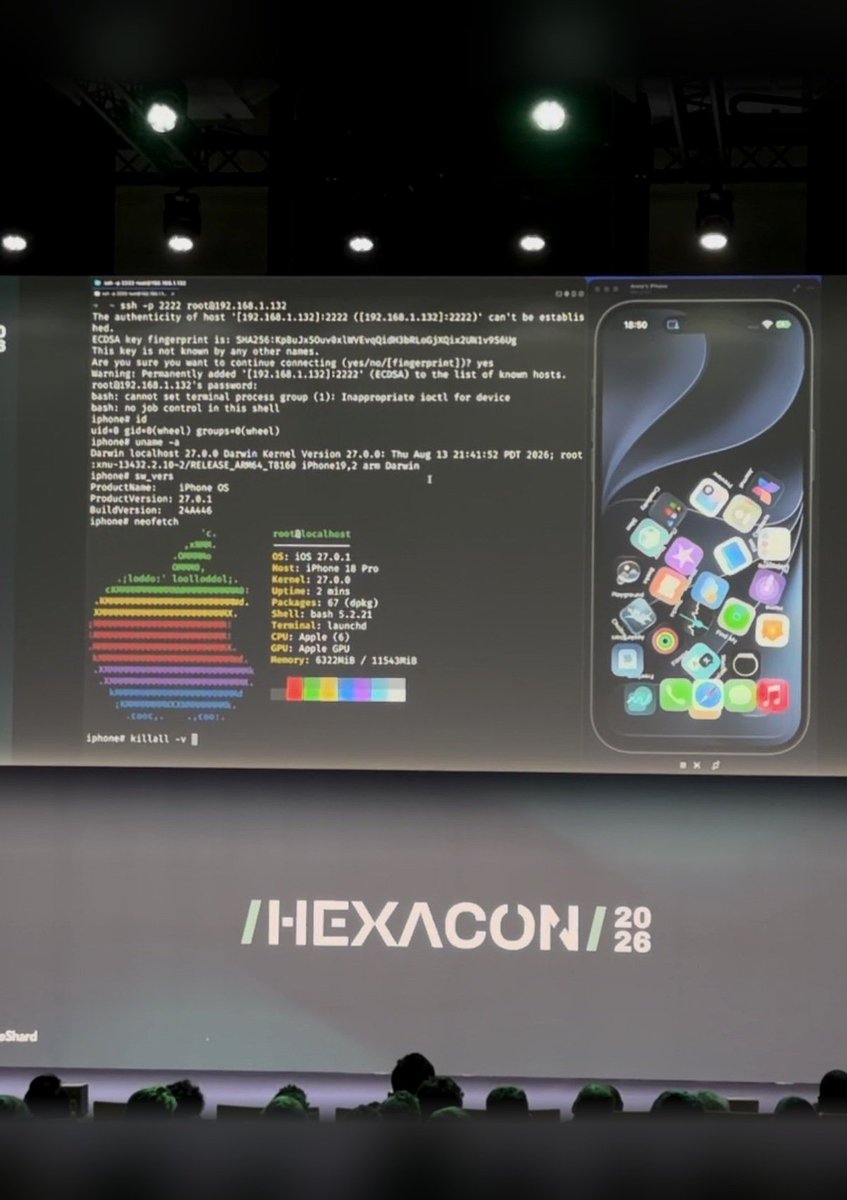
On 2026-10-16 at Hexacon in Paris, security research firm Calif (calif.io) showed an untethered jailbreak demo on an iPhone 18 Pro running iOS 27.0.1. Their company account summarized the four clips and closed with: *“Everything will be released in due time.”* (@calif_io). This page is a reverse-engineering / defensive reading of that public on-screen evidence — not a jailbreak howto, not a PoC, and not permission to modify devices you do not own or lack written authority for (/compliance/, /faq/legal-boundary/).
Chinese twin: /zh/blog/calif-hexacon-ios27-untethered/. If you are new to authorized RE tooling on this site, start with /blog/rea-beginner-guide/ and the install demo /docs/install-demo/.
Snapshot (public reporting, 2026-10-16)
| Item | Value | Source |
|---|---|---|
| Event | Hexacon 2026, Paris | Calif thread + coverage |
| Demo day | 2026-10-16 | @calif_io |
| Device (on-screen) | iPhone 18 Pro (iPhone19,2) | Stage slide / attendee photos |
| OS (on-screen) | iOS 27.0.1 build 24A446 | Stage slide |
| Kernel string | Darwin 27.0.0 | uname / neofetch class fields |
| SoC class (reported) | T8160 | Public coverage of slide |
| Persistence claim | Untethered — root survives reboot | Calif + Glitchwire |
| Boot → root shell | ~2 minutes after reboot (uptime on demo) | @IntCyberDigest, Glitchwire |
| SSH | Port shown 2222, session as root (uid=0) | Stage slide |
| Package surface | neofetch ~67 dpkg packages | Stage slide |
| RAM class (display) | ~12 GB class | Stage slide |
| Public tool / CVE | None yet — “released in due time” | Calif |
| AI-assisted finding | Reporting says AI helped chain discovery | Heise (phrase as reporting) |
Treat every number above as evidence you can re-check against the public slide/clips, not as a recipe. Stars, likes, and conference applause ≠ permission and ≠ a downloadable tool.
What “untethered” means for reverse engineers
In jailbreak vocabulary (conceptual only):
| Mode | After a full reboot… | Why REs care |
|---|---|---|
| Tethered | Persistence usually dies; you need a computer-side re-apply / boot helper to get root again | Useful for lab sessions; weaker model of “real” attacker persistence |
| Semi-tethered | Boots stock; jailbreak features return only after a user/tool step | Common middle ground in historical public tools |
| Untethered | Root / SSH / package manager state survives reboot without a tethered helper | Strongest public signal that the chain reaches early boot / durable privilege — the class spyware operators also chase |
For reverse engineers and defenders, an untethered demo is less about “cool SSH wallpaper” and more about attack-surface priority: whatever landed can re-assert control after power cycles. That changes how you triage patches, telemetry, and “is my fleet actually clean after reboot?” questions. It does not mean you should seek a tool, flash a random IPA, or jailbreak a production phone.
How to read the public on-screen evidence
The Hexacon slide and clips show operator-familiar fields. Read them as identity + posture, the same way you read a triage screenshot — field meaning only:
| Field / command (as shown) | What it usually means | What it does not give you |
|---|---|---|
sw_vers / iOS 27.0.1 / build 24A446 | Exact userspace release under demo | Patch status of your phone; exploit path |
uname / Darwin 27.0.0 | Kernel marketing / version string class | Exploit primitives |
iPhone19,2 | Hardware product type (iPhone 18 Pro class) | Board-level schematics or unlock keys |
uid=0 / root shell | Process is privileged | How privilege was obtained |
| SSH on port 2222 | Remote shell listener chosen for the demo | A public service you should open on the internet |
neofetch ~67 dpkg | A Debian-style package set is present under the jailbreak userspace | A software bill of materials for Apple stock iOS |
| ~12 GB RAM class display | Device memory class shown by the info tool | Proof of a specific exploit heap layout |
| Uptime ~2 min post-reboot | Persistence claim timing for the demo narrative | Guaranteed timing on other devices |
Authorized RE habit: copy the strings you can see, cite the source clip, and stop. Do not invent missing stack traces, CVE IDs, or “probably WebKit then kernel” chains. Calif has not published a technical write-up yet.
Four-clip arc: attack-surface storytelling
Calif’s thread framed four demos in order. Read them as a narrative of surface → message path → device persistence → industry joke, not as a lab syllabus.
1) Signal 1-click
Messaging clients are high-value because a single crafted artifact can reach a human without “install this IPA.” For RE/security posture: treat rich parsers (media, links, previews) as first-class attack surface — same lesson as PDF/font bugs in other stacks. This article does not reproduce any payload.
2) iMessage
Public write-ups note Calif teased iMessage alongside Signal (Glitchwire, Pasquale Pillitteri). Attendee social claims about specific document types were not independently verified in those pieces — keep that uncertainty label if you cite them.
3) Untethered jailbreak (main course)
This is the clip defenders should scrub for posture signals: reboot → still root → SSH listening → package manager present. It answers “does control survive power cycle?” with a stage yes. It does not answer “how,” and this site will not invent that answer.
4) “APT = Apple Persistent Threat”
The joke lands because persistence is the product category commercial spyware sells. A conference demo and a mercenary implant are different actors and legal regimes; the capability class (reboot-surviving privilege on a fully patched-looking phone) is what operators compare.
Public research demo vs spyware industry capability
| Dimension | Public research / conference demo (this class) | Spyware industry capability (public reporting level) |
|---|---|---|
| Goal of publication | Credibility, recruiting, responsible timeline (“in due time”) | Covert access for paying customers |
| Artifact you can download today | None from Calif for this demo | Not a GitHub “jailbreak”; closed implants |
| Evidence style | Stage slides, neofetch, SSH wallpaper | Rare public tear-downs (labs, journalists) |
| User action if curious | Update OS; wait for vendor advisories; do not fetch random tools | Irrelevant — you are not the customer |
| Overlap | Both care about untethered / zero-click / messaging parsers | Same |
| Legal / ethics frame | Authorized research + eventual disclosure norms | Highly regulated / often abusive targeting — see public Citizen Lab–class reporting |
Glitchwire explicitly places Hexacon-class techniques in the same capability neighborhood as recent public spyware reporting, while stressing no public exploit for this Calif demo. That is the right dual message: take the surface seriously; do not play with unverified binaries.
Link back to REA (authorized understanding only)
rea.run teaches authorized reverse engineering: Evidence habits, doctor-green tooling, and fix-priority thinking — not device cracking.
| Need | Where on this site |
|---|---|
| Beginner Evidence habit | /blog/rea-beginner-guide/ |
| Visual workbench around REA | /blog/eleven-rea-workbench/ |
| Install / MCP demo path | /docs/install-demo/ |
| Compliance / legal boundary | /compliance/ · /faq/legal-boundary/ |
| What you may analyze | /faq/what-can-i-analyze/ |
Hard warning: there is no public Calif iOS 27 untethered tool as of this writing. Random sites titled “iOS 27 jailbreak download” are scam / malware magnets. Do not sideload them. Do not paste “install scripts” from strangers. Wait for primary sources (Calif, Apple security updates, coordinated advisories).
Checklist for everyday users
- [ ] Keep iPhone OS current (Settings → General → Software Update); demo day ≠ your patch day forever.
- [ ] Treat unexpected Signal / iMessage / SMS attachments from strangers as hostile until proven otherwise.
- [ ] Do not search-install “iOS 27 jailbreak”, “untethered IPA”, or Telegram “free JB” packs.
- [ ] If a device behaves oddly after a suspicious message (battery, network, config profiles), use official Apple support / enterprise MDM playbooks — not forum binaries.
- [ ] Prefer Lockdown Mode only when your threat model warrants it (Apple’s documented high-risk feature) — this article is not a personal threat assessment.
Checklist for reverse engineers / security practitioners
- [ ] Scope: own / authorized / clean-room targets only (/compliance/).
- [ ] Capture public strings from slides/clips into your notes with source URLs; do not invent CVE IDs.
- [ ] Map fields (
sw_vers, Darwin, product type, uid, listen port, package count) to your triage template — same discipline as malware screenshot intake. - [ ] Separate questions: (1) what surface was demonstrated, (2) what is patched in your fleet builds, (3) what telemetry would detect reboot-surviving listeners — still without building a public weapon.
- [ ] Prefer vendor advisories + coordinated disclosure over conference rumor chains.
- [ ] Use REA / Eleven for authorized binaries and fixtures (/blog/eleven-rea-workbench/, /docs/install-demo/) — never as a path to crack phones.
- [ ] If you research Apple stacks professionally, follow Calif’s own public research index when they publish: calif.io/research/apple.
Compliance
- This page explains public conference evidence and defensive posture. It contains no exploit steps, payloads, PoCs, or jailbreak install tutorials.
- Do not jailbreak devices you do not own or lack written authority to modify.
- No encouragement to seek or distribute unauthorized jailbreak tools.
- Targets for REA workflows remain own / authorized / open / clean-room (/compliance/, /faq/legal-boundary/).
- rea.run is a community operator guide; footer disclaimer stays. Not affiliated with Calif, Hexacon/Synacktiv, or Apple — we cite public posts and reporting only.
- Media under
/media/blog/calif-hexacon-ios27-untethered/are hosted copies of public demo clips/stills for this article.
Sources
- Calif primary thread: x.com/calif_io/status/2111080240978223545 (2026-10-16; “Everything will be released in due time.”)
- Breaking summary: x.com/IntCyberDigest/status/2111044864553152570
- Glitchwire: Calif Demonstrates Untethered iOS 27.0.1 Jailbreak at Hexacon…
- Heise: Untethered Jailbreak für iOS 27.0.1… (AI-assisted finding phrased as reporting)
- Pasquale Pillitteri: Jailbreak iPhone 18 Pro iOS 27 Calif Hexacon
- Calif Apple research index: calif.io/research/apple
- On-site: /blog/rea-beginner-guide/ · /blog/eleven-rea-workbench/ · /docs/install-demo/ · /compliance/ · /faq/legal-boundary/ · /zh/blog/calif-hexacon-ios27-untethered/
FAQ
| Question | Short answer |
|---|---|
| Is there a public iOS 27 untethered jailbreak tool? | No as of this article — Calif said release comes “in due time.” |
| Should I download a “free iOS 27 JB”? | No — almost certainly scam/malware. |
| What does untethered mean here? | Root/SSH/package state survives reboot without a tethered computer helper (conceptual). |
| Does this page teach how to reproduce the demo? | No — evidence reading + posture only. |
| Device/OS cited? | iPhone 18 Pro (iPhone19,2), iOS 27.0.1 build 24A446, Darwin 27.0.0 (on-screen). |
| How does this relate to REA? | Authorized understanding of attack surface and Evidence habits — not phone cracking. |