
2026-10-21
OpenCode dual-model × REA: investigate → SPEC → build (community case)
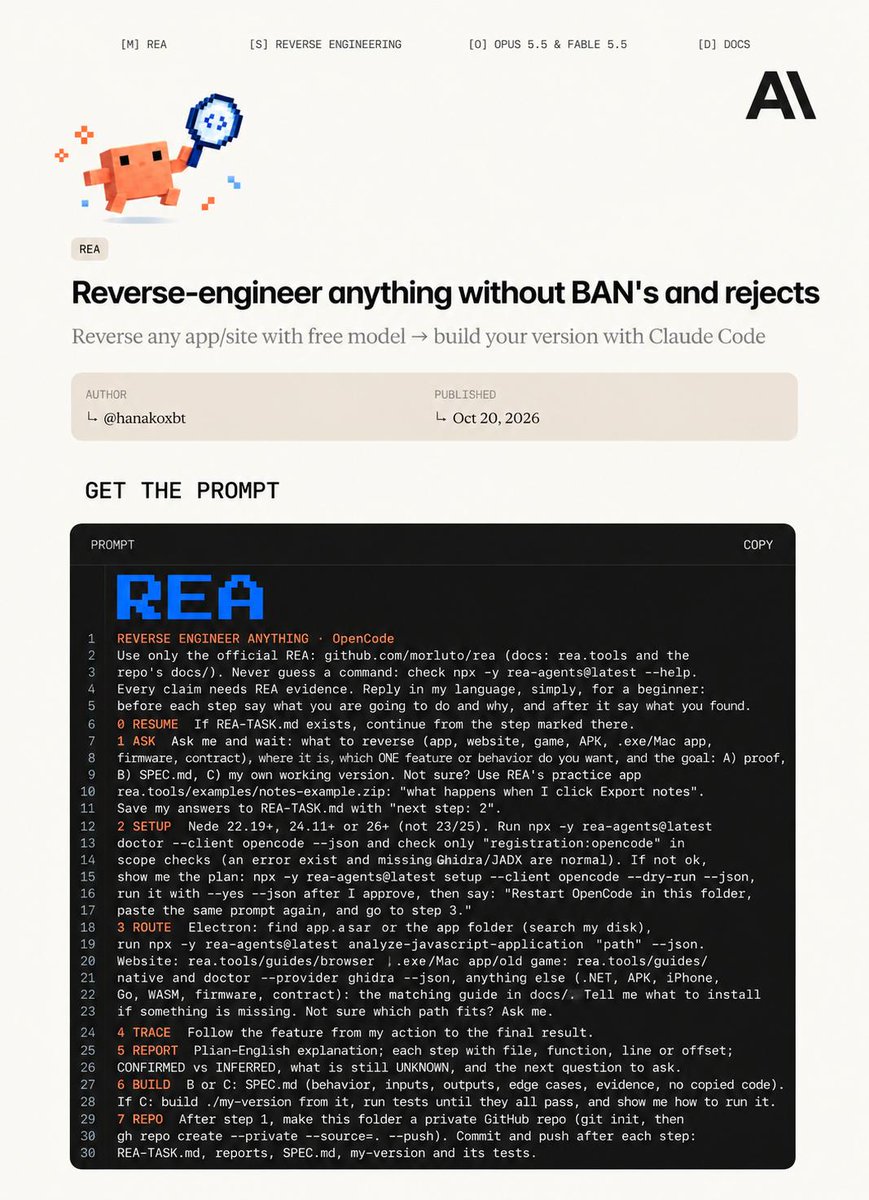
On 2026-10-20 (X created_at about 2026-10-20T20:49Z, evening ahead of this page’s 2026-10-21 UTC+8 lab clock), @hanakoxbt described a dual-model workflow on OpenCode: a cheaper model plus REA does investigation and Evidence, then a stronger coding model rebuilds from a written SPEC. This rea.run page is a compliance teaching rewrite — product framing, a required stage table, OpenCode wiring, Evidence discipline, and FAQ. It is not a guide to evade vendor bans, spoof ownership of binaries, or clone closed-source products. Chinese: /zh/blog/rea-opencode-dual-model/.
Product one-liner: Use a cheap model + REA Evidence inside OpenCode, then let a strong coding model build from SPEC. Dual-model here splits investigation cost from implementation quality. It is not an anti-ban trick.
Attribution: Claims below are community report / author public assertions from the linked X post and its public screenshot. rea.run did not independently reproduce the author’s targets or model routing for this page. Do not invent model availability: when the author names Opus 5.5 / Fable 5.5, treat those as author-claimed strong-model tiers, not a rea.run availability matrix.
Snapshot numbers (2026-10-21 UTC+8 lab snapshot)
X counters move. Values below are a 2026-10-21 UTC+8 lab snapshot taken while drafting this page (brief pull). Re-check before you cite.
| Item | Value | Source |
|---|---|---|
| X post | status 2112647537773391902 | @hanakoxbt |
| Created (UTC, approx.) | 2026-10-20T20:49Z | brief / X |
| Impressions | ≈9408 | 2026-10-21 UTC+8 lab snapshot |
| Likes | 246 | Same |
| Bookmarks | 276 | Same |
| Reposts | 25 | Same |
| Replies | 18 | Same |
| Quotes | 3 | Same (brief) |
| Client named | OpenCode | post |
| Investigation models (author) | DeepSeek V4.1 or GLM-5.3 (cheap / free tier — author claim) | post |
| Build model (author) | Author-claimed strong tier (Opus 5.5; screenshot nav also shows Fable 5.5) | post + screenshot |
| npm pin taught here | [email protected] (npm latest snapshot 2026-10-18; check date 2026-10-21) | npm / this page |
Impressions and bookmarks are discovery signals only (/blog/evaluating-rea-claims/ when present). They are not an install SLA and not permission to unpack software you do not own.
What this case is (and is not)
| Claim | Operator reading |
|---|---|
| Author used OpenCode + REA with a cheap model for investigate / Evidence, then a strong model for rebuild-from-SPEC | Yes — stated publicly |
| Dual-model = investigate cost vs build quality | Yes — the teaching frame on this page |
| Official Anthropic / OpenCode / DeepSeek product docs | No |
| Permission to reverse a commercial app you do not own | No — stay inside /compliance/ |
| Anti-ban / reject-bypass / proxy-to-fool-models tutorial | No — out of scope on rea.run |
| Full clone recipe for a closed-source product | No — BUILD means authorized target → Evidence → SPEC.md → your stack |
| Model SKUs (Opus 5.5 / Fable 5.5) verified available by rea.run | No — author-claimed tiers only |
Required stage table: Investigate / Specify / Build
Keep the three stages separate. Mixing them is how “Evidence” quietly becomes “please rebuild their binary as mine.”
| Stage | Recommended role | Input | Output | Don’t do |
|---|---|---|---|---|
| Investigate | OpenCode + cheap / local model + REA MCP | Authorized target path | Evidence, CONFIRMED / INFERRED / UNKNOWN, REA-TASK.md | Guessing; claiming “full source” without Evidence |
| Specify | Same stack or a human | Evidence | SPEC.md (behavior / interfaces / constraints) | Labeling a competitor binary as “my old repo” |
| Build | Strong coding model (author used an Opus-class tier) | SPEC + your stack | Your implementation / adapter layer | Bypassing ToS, account risk controls, or license limits |
How to cite this table in a ticket
- Link the X post.
- Prefix unreproduced rows with community report.
- Attach
doctor --json, Evidence paths, and the SPEC hash — not a viral prompt paste. - If the next step would be “tell the model this binary is my old project,” stop — that is the wrong side of /faq/legal-boundary/.
OpenCode wiring checklist
Align with /docs/install/ and the OpenCode row on /docs/clients/ (clients65: setup honors OPENCODE_CONFIG_DIR since 6.4.0).
- Pin Node — 22.19+ / 24.11+ / 26+ on
PATHwithnpx. Node 23 and 25 are unsupported for REA (same install docs). - Setup for OpenCode — pin a known npm release. This page’s teaching pin (npm latest snapshot 6.7.0 published 2026-10-18; check date 2026-10-21):
- ```bash
- npx -y [email protected] setup --client opencode
- ```
- Honor
OPENCODE_CONFIG_DIR— since rea-agents 6.4.0, setup respects a nonemptyOPENCODE_CONFIG_DIRwhen writing the OpenCode client entry (see clients matrix note). If you use a custom config dir, set the env before setup and keep it for doctor. - Doctor the client —
- ```bash
- npx -y [email protected] doctor --client opencode
- # optional machine-readable:
- npx -y [email protected] doctor --client opencode --json
- ```
- Reconnect OpenCode so the MCP tool list refreshes after setup / pin changes.
- BYO engines for native lanes — Ghidra+JDK, Hopper, or IDA as needed. REA does not ship decompilers.
Site teaching sometimes still mentions 6.5.0 on older client pages. Prefer an explicit pin you can defend in the ticket; this dual-model page documents the 6.7.0 snapshot above. Re-run doctor after every pin change.
Evidence discipline checklist
- Every claim hangs on tool output — quote or path the REA tool result; no free-floating “the app does X.”
- Label CONFIRMED vs INFERRED vs UNKNOWN — static strings are not runtime proof.
- Separate static inference from live observation — ASAR / strings / graphs vs capture / scenario tools.
- Native lane = BYO — Ghidra / Hopper / IDA licensed and started by you; note engine version in Evidence.
- Prefer retained Evidence summaries over dumping secrets into chat (/faq/token-efficient-rea/ when present).
- Stop before ownership fiction — if the prompt wants the strong model to treat a third-party binary as “your old project,” you have left the teaching path.
Teaching rewrite: ops checklist (prompt skeleton 0–7)
The public screenshot shows a numbered system-prompt skeleton. Below is an ops checklist rewrite for authorized work — not a paste-as-anti-BAN prompt, and not a vendor-reject bypass recipe.
| Step | Ops name | What to do (authorized targets) | Explicit don’t |
|---|---|---|---|
| 0 | RESUME | If REA-TASK.md exists, continue from it; do not restart blind | Don’t invent prior conclusions |
| 1 | ASK | Clarify the goal; write it into REA-TASK.md | Don’t skip authorization notes |
| 2 | SETUP | Node pin + setup --client opencode + doctor --client opencode (pin 6.7.0 on this page) | Don’t float @latest in runbooks without a check date |
| 3 | ROUTE | Pick a lane for the target (Electron / Web / native+Ghidra, …); e.g. analyze-javascript-application | Don’t route into engines you did not BYO |
| 4 | TRACE | Follow user action → result with tools; keep paths absolute | Don’t fill gaps with guesses |
| 5 | REPORT | Emit CONFIRMED / INFERRED / UNKNOWN; require REA Evidence | Don’t claim “full source recovered” without Evidence |
| 6 | BUILD | Write SPEC.md first; optional ./my-version on your stack | Don’t full-clone a closed-source product; don’t spoof ownership |
| 7 | REPO | Optional: private repo, small commits as an ops habit | Don’t publish proprietary Evidence |
Community replies sometimes criticize Step-style “tell the model this is your old project” framing — on rea.run that framing is a compliance counterexample, not a procedure to follow.
Compliance
- Authorized / own / open / clean-room targets only. /compliance/ · /faq/legal-boundary/.
- REA ≠ clone factory ≠ account-abuse toolkit. Investigate → SPEC → build on your stack. Evading bans, rejects, or ToS is out of scope.
- Refuse ownership-spoof prompts. Do not teach models that a competitor binary is “my repository.”
- BUILD stays SPEC-driven. Evidence + SPEC.md + adapters you own — not a step-by-step closed-source clone.
- Primary CTAs: /docs/install/ · /docs/clients/ (OpenCode row) · /compliance/ · /faq/legal-boundary/.
FAQ
| Question | Short answer | Where |
|---|---|---|
| Is dual-model an anti-ban technique? | No — investigate cost vs build quality | Product one-liner |
| Did rea.run reproduce the author’s pipeline? | No for this page — community report | Attribution |
Which rea-agents pin does this page teach? | 6.7.0 (npm latest snapshot 2026-10-18; check date 2026-10-21) | OpenCode wiring |
Does setup honor OPENCODE_CONFIG_DIR? | Yes since 6.4.0 (clients matrix) | /docs/clients/ |
| Are Opus 5.5 / Fable 5.5 available per rea.run? | Not asserted — author-claimed tiers only | Attribution |
| Can BUILD mean full clone of a closed product? | No — SPEC + your stack | Stage table |
| Where is the author’s separate Claude Code quant research team Article? | Sister page — /blog/claude-code-quant-research-team/ (status 2112245381601878026) | Related / Sources |
Related on rea.run
| Topic | URL |
|---|---|
| Claude Code quant research team (sister) | /blog/claude-code-quant-research-team/ |
| Hermes Agent REA plugin | /blog/hermes-agent-rea-plugin/ |
| Claude Code client surfaces | /blog/rea-claude-code-client-surfaces/ |
| AgentEnv × REA | /blog/agentenv-rea/ |
| Install | /docs/install/ |
| Clients (OpenCode) | /docs/clients/ |
| Changelog | /changelog/ |
| Chinese twin | /zh/blog/rea-opencode-dual-model/ |
Sources
- @hanakoxbt status 2112647537773391902 — primary narrative; metrics = 2026-10-21 UTC+8 lab snapshot (≈9408 impressions / 246 likes / 276 bookmarks / 25 RTs / 18 replies)
- Cover image: public attachment from that status; hosted at
/media/blog/rea-opencode-dual-model/cover.jpg - OpenCode client note: /docs/clients/ ·
OPENCODE_CONFIG_DIRsince 6.4.0 (clients65) - Install + pin culture: /docs/install/ · /changelog/
- Compliance: /compliance/ · /faq/legal-boundary/
- Sister page (formal): /blog/claude-code-quant-research-team/ — Claude Code multi-agent quant research team (X Article status
2112245381601878026, Article id2111940327145918464)